
John Paul II Academy has a curriculum based on the Louisville Archdiocesan Curriculum Framework with goals and outcomes consistent with the school’s mission. Teachers provide activities that will ensure we meet or exceed all standards.
Standards are assessed through a variety of means, which include performance assessments, checklists, criterion referenced tests, and standardized tests. Student progress and assessment results are reported to parents or guardians through progress reports, conferences, graded papers, and standardized test reports.
Assessment data is used by certified staff to improve instruction and to guide staff development. Differentiation is emphasized. Disciplines are integrated where appropriate, and technology is integrated throughout the curriculum. A variety of instructional methods are used by teachers. The school recognizes the achievements of its students and is recognized by the community for its achievements.
Spiritual: To provide a loving, Christian environment where children will be introduced to prayer, church, the Bible, and the Golden Rule.
Academic: To provide pre-reading, pre-math, and pre-writing skills, listening and following directions, increasing attention span, problem solving, and language enrichment.
Emotional: To establish a positive self-concept within each child and help him/her achieve self-confidence and self-control.
Social: To instill in each child a concept of himself/herself as a worthy individual, a good friend to his/her classmates, a good learner, and an eager, cooperative participant in school activities.
Physical: To develop small and large motor skills, as well as enhance overall physical coordination in our effort to educate your child on the importance of staying active.
We know how crucial visiting is in gaining a better sense of a school’s community. Schedule a visit to determine if our school meets your educational interests and goals.
The curriculum for Pre-Kindergarten follows a thematic approach based around the seasons and holidays. The goals of the program include:
Spiritual —To provide a loving, Christian environment where children will be introduced to prayer, church, the Bible, and the Golden Rule.
Academic — To provide pre-reading, pre-math, and pre-writing skills, listening and following directions, increasing attention span, problem-solving, and language enrichment.
Emotional — To establish a positive self-concept within each child and help him/her achieve self-confidence and self-control.
Social — To instill in each child a concept of himself/herself as a worthy individual, a good friend to his/her classmates, a good learner, and an eager, cooperative participant in school activities.
Physical — To develop small and large motor skills, as well as enhance overall physical coordination in our effort to educate your child on the importance of staying active.
Kindergarten is a caring place, a sharing place, a learning place, and a growing place that offers a full academic curriculum, aligned with the Kentucky, Archdiocesan and Common Core standards. We supply instruction in Reading Readiness, Language Arts, Mathematics, Religion, Science, and Social Studies The children are able to explore, create, and master the real world of people and things. Independent thinking, curiosity, and creativity are valued, so that children may discover their own special qualities, talents, and strengths. Opportunities for creative expression are provided through music, creative movement, large and small motor activities, and problem-solving related to sharing, listening, making decisions, discussing, and setting goals. The whole child is nurtured so that optimum development of skills in the social, emotional, spiritual, cognitive, academic, and creative areas are stimulated.
Students learn the Our Father, Hail Mary, and the Glory Be. We focus on faith-based life with a heavy influence of how God lives and shows Himself in our everyday life. Church etiquette, liturgy responses, and how to take care of God’s gifts of life are also stressed.
First Grade encourages the development of essential language arts skills including writing, language, grammar, spelling, and reading, with an emphasis on phonics and independent reading strategies incorporating the Reading First Initiative adopted by the Archdiocese of Louisville.
First Grade math consists of many new concepts. We not only add, subtract, and learn basic math facts, we also learn to apply reading strategies to solve story problems involving basic operations, measurement, time, money, and two-digit math calculations.
We explore life, earth, and physical science through projects and activities in order to discover our world and the wonderful things it contains.
The study of our world in respect to our school and family, where we live, and how we grow and change to become productive citizens are some of the main topics covered. We also study our history and how it affects our lives today.
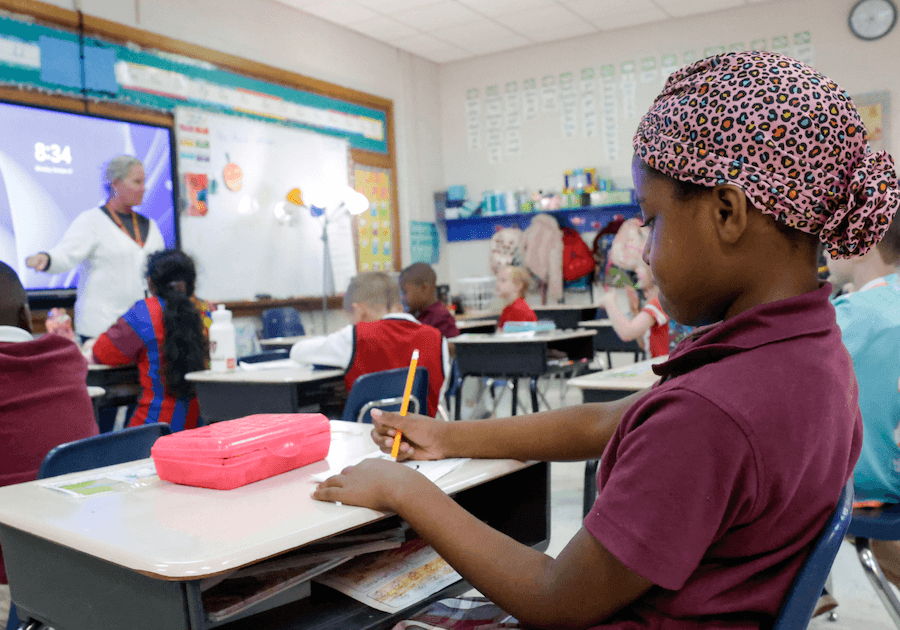
Each lesson begins with a prayer followed by the teachings of the truths of the Catholic faith. Students respond through prayer and the way they live out the discipleship. Students will also prepare for the sacraments of Reconciliation and Holy Eucharist. They will use an integrated sacramental preparation program. The lessons will help students grow in their faith in the Catholic tradition.
The program teaches students to read and use comprehension strategies. The Scott Foresman Reading Street series uses a variety of topics. Fiction and nonfiction stories help students to decode words, build vocabulary, increase fluency, and improve comprehension. Students use writing to express themselves. They will use correct grammar, spelling, capitalization, and organization of sentences to enhance their stories. Prewriting helps students communicate their ideas. Editing helps them to revise their final document.
The concepts are taught using the Houghton Mifflin textbook and manipulatives for “hands-on” activities. Students learn problem-solving strategies, addition, and subtraction 1-18, addition and subtraction using regrouping, multiplication, measurement, geometry, money, time, fractions, and place value.
There will be a variety of main topics using a textbook and nonfiction books. Students will use experiments and research projects to expand their scientific knowledge.
Students will learn about communities, geography, cultures, economics, history, and citizenship. These units will be enhanced with special projects throughout the year.
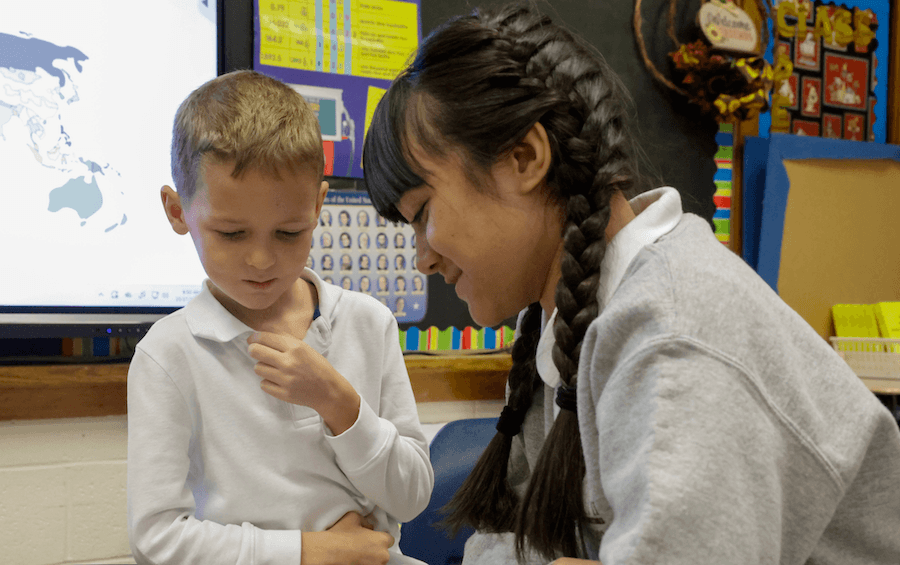
Students will be focusing on what defines a Catholic. We will be studying about God as the Father, Son, and Holy Spirit. They will use the text, Bible readings, prayers, discussion, and activities to help us on our journey of living out the words we read and speak.
This area focuses on the various aspects of communication: reading, writing, spelling, listening, and speaking. It involves daily experiences that help the students develop impressions of quality literature, a chance to interact with the material through classroom discussion, drama, music, art, writing, and finally the opportunity of self-expression during which time the children will apply their above experiences into their real life situations.
In the beginning, students will review addition and subtraction facts and then go on to adding and subtracting two and three digit numbers with and without renaming. As the year progresses, we will work with money, telling time, fractions, multiplication, and division. It is important to memorize the basic facts by practicing at home. It would be very helpful if you could purchase or make flash cards to use in practicing.
We will be studying units about Landforms, Natural Resources, Animal, Habitats, Solar Systems, Human Digestive System, States of Matter, and Heat and Sound. Students will be involved in independent and group projects.
Students will explore geography, history, multiculturalism, citizenship, economics, government, thinking skills, and current events around the world.

Learning about the Catholic faith is an integral part of the school day. We attend Liturgy once a week and celebrate the sacrament of Reconciliation during the year. In our religious studies, we cover the Beatitudes and Ten Commandments as part of the Religion curriculum.
We study many concepts in Fourth Grade. The focus for math is mastery of the four basic operations: addition, subtraction, multiplication, and division. In Language Arts, we focus on independent reading comprehension and developing strong writing skills. This is also the year students all over Kentucky study our great state! We try to take a field trip to Frankfort, our state capitol.

We will learn the Ten Commandments, the Seven Sacraments, and parts of the Mass. We will compile a faith book of what we learn.
We will study parts of speech and review the components of an excellent paragraph. We will write reports, reflections, narratives, and stories. Vocabulary words are assessed for spelling, word meanings, and usage in sentences. We will explore a variety of novels and practice using many comprehension skills. You will share your knowledge by creating dioramas, written and oral reports, skits, and in class discussions.
We use all the math skills already learned. The challenge is to solve many kinds of problems using those skills and more. Fractions, decimals, geometry, and measurement are studied this year.
We will learn about plant and animal cells, plant reproduction, biomes, the human skeletal system, chemical reactions, acids and bases, weather and clouds, simple machines, forces of energy, and much more. We will use hands-on activities to explore.
Have you ever enjoyed the savory goodness of a Colonial Tea or listened to a Civil War soldier tell of the hardships of everyday life? Have you ever tried to run your own business? Have you ever wondered about the explorers who first visited the shores of North America, or the settlers who made our country so great with their diversity? Come along on our journey of discovery as we experience these and other exciting activities
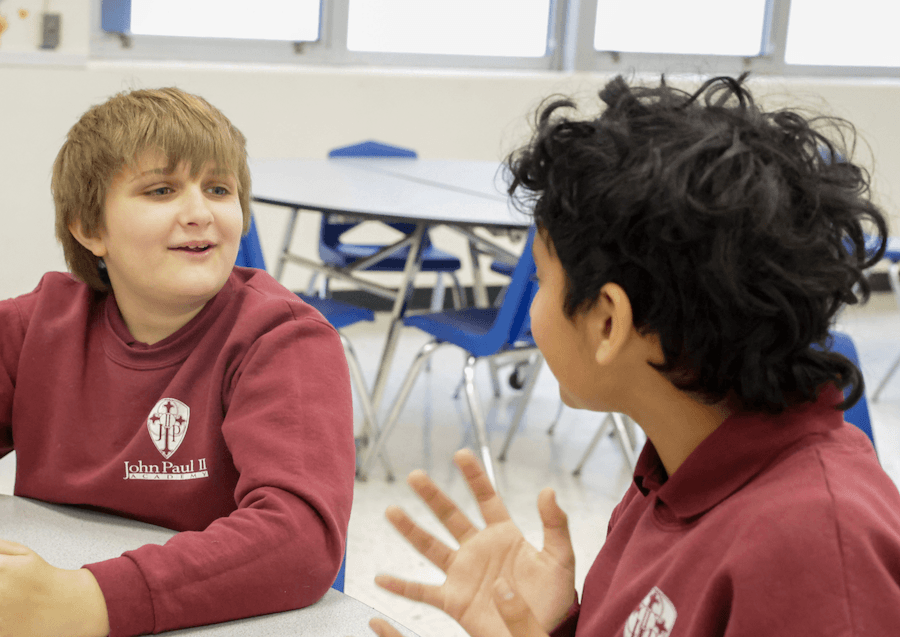
The academic goals at the Middle School level are to:
6th – Old Testament / Step-By-Step program emphasis on babies and children
7th – New Testament / Step-By-Step program emphasis on refugee issues
8th – Confirmation Preparation / Step-By-Step program emphasis on the homeless
Analysis of different genres of literature, development of vocabulary, and comprehension skills incorporating critical thinking. Textbooks and novels are used.
Development of effective writing skills utilizing proper grammar and language mechanics.
6th – Accelerated Math Course focusing on skills needed for Pre-Algebra
7th – Pre-Algebra
8th – Algebra I
6th – Earth Science – study of rocks, minerals, changing surface and space.
7th – Life Science – study of living systems
8th – Physical Science – study of matter, motion, forces, and energy
6th – Physical & cultural geography
7th – Study of ancient history from the earliest civilizations to 1500’s
8th – American History with an emphasis on government and current events
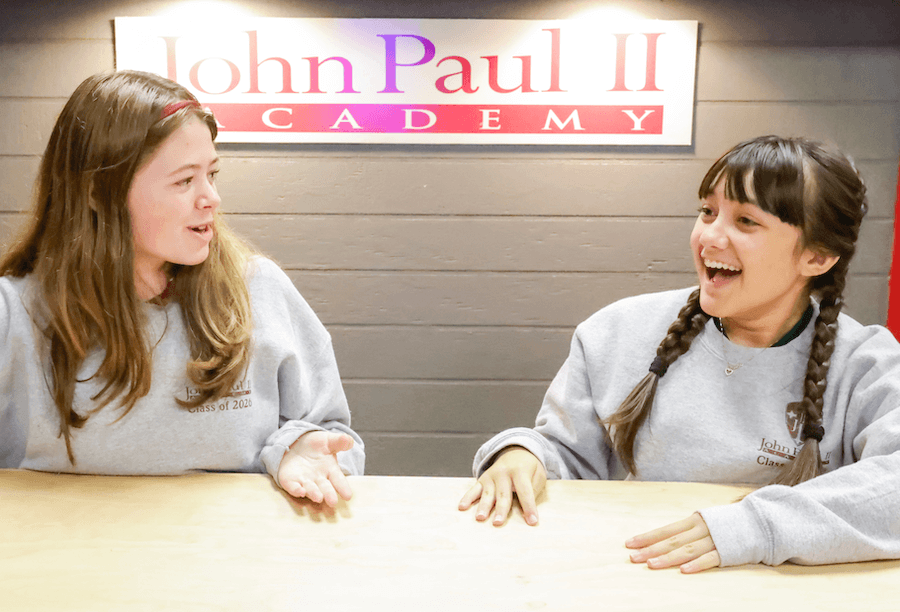
The purpose of the John Paul II Library is to provide the research tools which permit students to take the first steps in becoming independent learners. The John Paul II Library also promotes great literature through book talks, recorded books, and visual media.
Art Class encompasses drawing, painting, collage, ceramics, and sculpture. We learn about artists, art history, and art techniques. We look at contemporary art as well as the masters. Through these tools, we learn problem-solving skills and self-expression. Art education plays a central role in fostering creativity, developing imagination, and enabling students to envision alternative possibilities.
Students will learn aspects of Google: Classroom, Docs, Slides, Sheets, and Sites, as well as the corresponding Apple programs. We will also review basic research methods utilizing the internet. Students in K-8 will learn computer science: coding. Projects are based on real-world situations: Research, Organizing, and Presentations.
Music instruction varies in each grade level. Students learn and sing religious, seasonal, patriotic, motion, and fun songs. They play rhythm instruments, tone chimes, and other musical instruments. In 4-6 grade, students learn to read music and play the recorder using a highly motivational program called Recorder Karate. Students are very involved in music for our weekly school Liturgies. We have several choir groups and students are cantors and instrumentalists. Instruction includes Great Composers, Musical Imagery, Instruments of the Orchestra, and History of Musical Theatre.
Physical Education at JPIIA is geared towards each individual student. Through skill development, activities, and games, each student will discover habits to become a life-long mover. Students will be able to demonstrate competency in many movement forms. The JPIIA student will be able to apply movement concepts and principles to the learning and development of motor skills. Through exploration, practice, and quality repetition, students will continue to grow in knowledge, awareness, and appreciation, while constructing a network of skills to become a lifelong mover. By the end of class, students should feel hot, sweaty, happy, and be confident in what they can accomplish.
John Paul II Academy thrives when families and school work together.
While every family’s availability is different, we encourage parents/guardians to stay engaged through regular communication, attending key events, and supporting school initiatives when possible.
Yes — John Paul II Academy has an active Parent Teacher Organization (PTO).
The PTO supports students, teachers, and school life through events, fundraising, room parents, appreciation initiatives, and more. All parents, grandparents, and caregivers are welcome to participate.
Families receive regular updates through school communications and teacher outreach.
For day-to-day information, parents can also use the FACTS Parent Portal.
Students in grades K–8 wear the regulation uniform each school day.
Pre-K students do not wear uniforms and should wear comfortable play clothing. For full details, see the Uniform Policies and Student Handbook linked above.
John Paul II Academy emphasizes student growth, responsibility, and respect.
When issues arise, families can expect communication and a step-by-step approach focused on helping the student learn and make better choices. For the most complete guidelines, refer to the Student Handbook.
Yes — families can log in to the FACTS Parent Portal for parent resources and school information.
Use the “FACTS Parent Portal Login” link to access.
Homework expectations vary by grade level and teacher.
In general, homework is designed to reinforce classroom learning and build strong study habits. If you have questions for your child’s grade, reach out to the teacher or the school office.
If your child will be absent, please notify the school office and your child’s homeroom teacher as soon as possible.
If the absence involves illness or ongoing needs, the school can help you coordinate next steps and any make-up work.
Yes. Many volunteer opportunities run through the PTO, including events, room-parent support, and school-wide initiatives.
You can indicate your interests on the Got-a-Minute form (in the registration packet) or contact the school office to get connected.
John Paul II Academy works closely with families to support students academically and personally.
Start by contacting your child’s teacher. If additional support is needed, the school can help coordinate next steps with student support staff.